
Cloud Data Warehouse

Clean analytics dashboard with charts

CASE STUDY SNAPSHOT

Designing a warehouse that makes listening behavior queryable.

This project follows the full path from semi-structured S3 logs to a Redshift star schema, showing how raw music-streaming events become a reliable analytics layer for product and business questions.
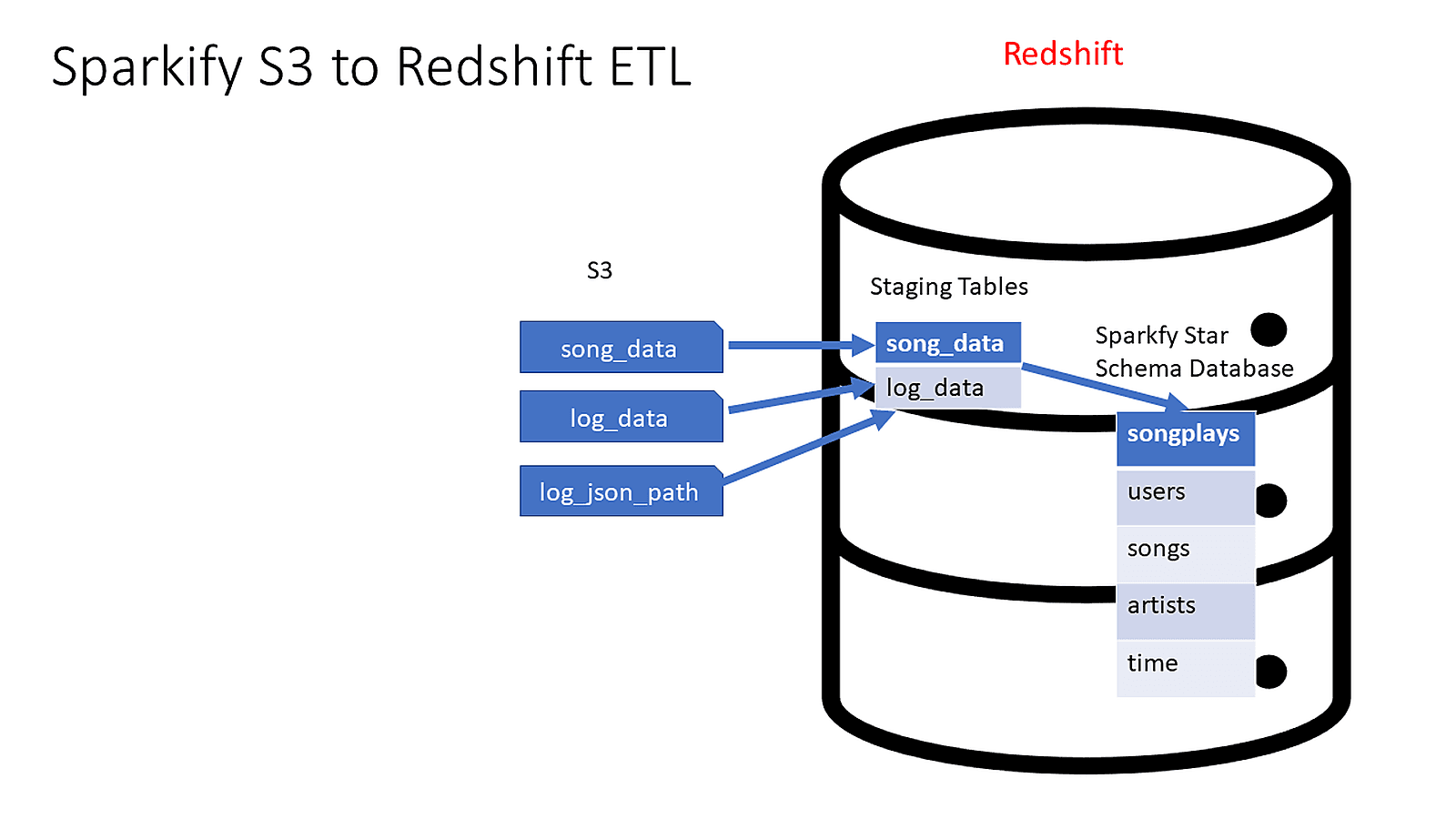
Project flow

A quick read of how the work moves from raw material to useful insight.

01

S3 events

Start with song metadata and user activity JSON stored in cloud storage.

02

Redshift staging

Load raw files into staging tables and validate the shape of the incoming data.

03

Star schema

Build fact and dimension tables for users, songs, artists, time, and songplays.

04

Analytics

Enable faster questions about engagement, popularity, and listening patterns.

In this project, I built a cloud-based data warehouse for the Sparkify music streaming platform using Amazon S3, Amazon Redshift, and SQL. The objective is to design an ETL pipeline that extracts semi-structured JSON data from cloud storage, stages it in Redshift, and transforms it into an analytics-ready dimensional model.


The workflow begins by loading song metadata and user activity logs from Amazon S3 into staging tables within Amazon Redshift using high-performance COPY commands. Separating raw data into staging tables provides a reliable foundation for data validation and simplifies downstream transformations.

After staging, I transform the raw datasets into a star schema with one fact table and multiple dimension tables, optimized for analytical workloads. The ETL process joins song and event data, filters user listening events, derives time-based dimensions, and structures the data to support efficient business intelligence queries.

Beyond building the ETL pipeline, the project demonstrates key data engineering concepts, including cloud-native data warehousing, dimensional modeling, bulk data loading, SQL-based transformations, and scalable analytics architecture on AWS. The resulting warehouse enables analysts to efficiently explore user listening behavior, song popularity, and engagement trends using an optimized Redshift database.

In this project, I built a cloud-based data warehouse for the Sparkify music streaming platform using Amazon S3, Amazon Redshift, and SQL. The objective is to design an ETL pipeline that extracts semi-structured JSON data from cloud storage, stages it in Redshift, and transforms it into an analytics-ready dimensional model.


The workflow begins by loading song metadata and user activity logs from Amazon S3 into staging tables within Amazon Redshift using high-performance COPY commands. Separating raw data into staging tables provides a reliable foundation for data validation and simplifies downstream transformations.

After staging, I transform the raw datasets into a star schema with one fact table and multiple dimension tables, optimized for analytical workloads. The ETL process joins song and event data, filters user listening events, derives time-based dimensions, and structures the data to support efficient business intelligence queries.

Beyond building the ETL pipeline, the project demonstrates key data engineering concepts, including cloud-native data warehousing, dimensional modeling, bulk data loading, SQL-based transformations, and scalable analytics architecture on AWS. The resulting warehouse enables analysts to efficiently explore user listening behavior, song popularity, and engagement trends using an optimized Redshift database.

hiker in nature

Subscribe to my Newsletter

Sign up to stay updated about my latest work and adventures. No Spam, No BS. Promise!

hiker in nature

Subscribe to my Newsletter

Sign up to stay updated about my latest work and adventures. No Spam, No BS. Promise!